
Walk-In Coolers for Kentucky Restaurants: How to Choose the Right Size, Type, and Setup
A walk-in cooler is one of the biggest equipment decisions a food business makes. It affects how much product you can stock, how fast your crew works, how much you spend on electricity, and whether a Friday night breakdown turns into a lost week of inventory. Yet many owners shop for one the way they would shop for a reach-in: pick a size that looks about right and hope the rest works out.
That approach is how kitchens end up with a box that is too small within two years, a unit crammed into the wrong spot, or a refrigeration system that struggles every July. This guide walks through the decisions that matter most when you are choosing walk-in coolers for a restaurant, grocery, bar, florist, or other cold-storage operation, so you can have a clear conversation with whoever sells and installs yours.
Do You Actually Need a Walk-In Cooler?
Not every operation does. A walk-in is a large insulated room with its own refrigeration system, built to hold bulk product at safe temperatures. It makes sense when you buy in volume, receive deliveries in cases or kegs, or run out of shelf space in your reach-in units.
Reach-in refrigerators still win in a few situations. A small cafe with a short menu and frequent deliveries may never need more than a couple of reach-ins and an under-counter unit. A walk-in also takes up real floor space and carries higher upfront and utility costs. If you are regularly stacking boxes on prep tables or keeping product in hallways to avoid overfilling your refrigerators, that is usually the sign it is time to think bigger.
Start With What You Store, Not the Box
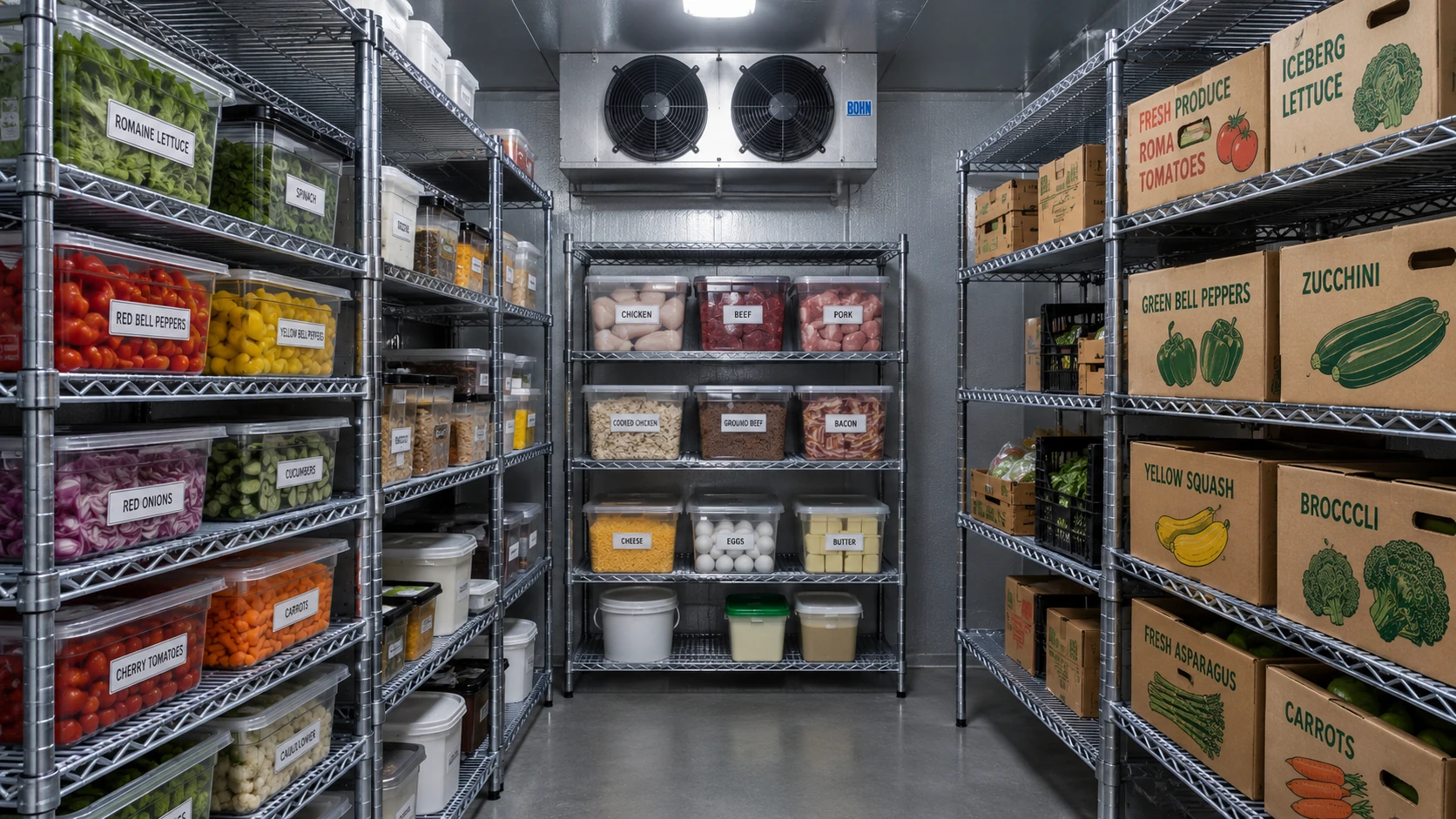
The best way to size and spec a walk-in is to work backward from your product. Before you look at dimensions, write down what actually goes inside.
- Menu mix: How much of your food is fresh versus frozen? A kitchen that cooks mostly from fresh ingredients needs far more cooler space than freezer space.
- Delivery schedule: A business that gets deliveries twice a week needs more storage than one that gets them daily.
- Packaging: Cases of produce, kegs, bulk dairy, and cut flowers all take up space differently. Kegs and floral buckets, for example, need very different shelving than boxed proteins.
- Peak periods: Size for your busiest week, not your average one. Holiday catering, festival season, and event weekends are when a cramped walk-in costs you the most.
- Growth: If you plan to add seating, a catering arm, or a second menu concept in the next few years, build that into the decision now. Expanding a walk-in later is usually more disruptive and more expensive than sizing up front.
A good dealer will ask you these questions before quoting anything. If a quote arrives without them, be cautious.
How to Size a Walk-In Cooler
Walk-ins are built from modular insulated panels, so they come in a wide range of footprints. Common sizes run from compact units around 6 by 6 feet up to large rooms well past 10 by 12 feet, and many suppliers offer custom dimensions on top of those standard sizes.
Bigger is not automatically better. An oversized walk-in costs more to buy, more to cool, and more to maintain, and a half-empty cooler is less efficient than a well-stocked one. Some suppliers suggest aiming to keep a walk-in reasonably full rather than mostly empty, though the exact target depends on your operation.
A practical sizing approach looks like this:
- Measure your available space carefully. Record the width, depth, and ceiling height of the area, and note anything that cannot move, such as columns, plumbing, or electrical panels.
- Account for the aisle. The shelving takes up a surprising amount of the interior. You need room to walk, turn, and pull product without banging into racks.
- Think in shelf space, not square footage. A tall, narrow footprint with good shelving can hold more than a wider box with poor organization.
- Plan door swing and clearance. The door needs room to open fully, and the area outside it needs to stay clear for carts and deliveries.
- Leave room for airflow. Evaporator fans need open space to move air, and overpacking shelves right up to the fan can cause uneven temperatures.
Indoor or Outdoor Walk-In Coolers
This is one of the first big forks in the road.
Indoor walk-ins sit inside your building, which protects the unit from weather and keeps staff close to the kitchen. They are convenient for daily workflow, but they use up interior square footage, and retrofitting one into an existing space can mean structural work and higher labor costs.
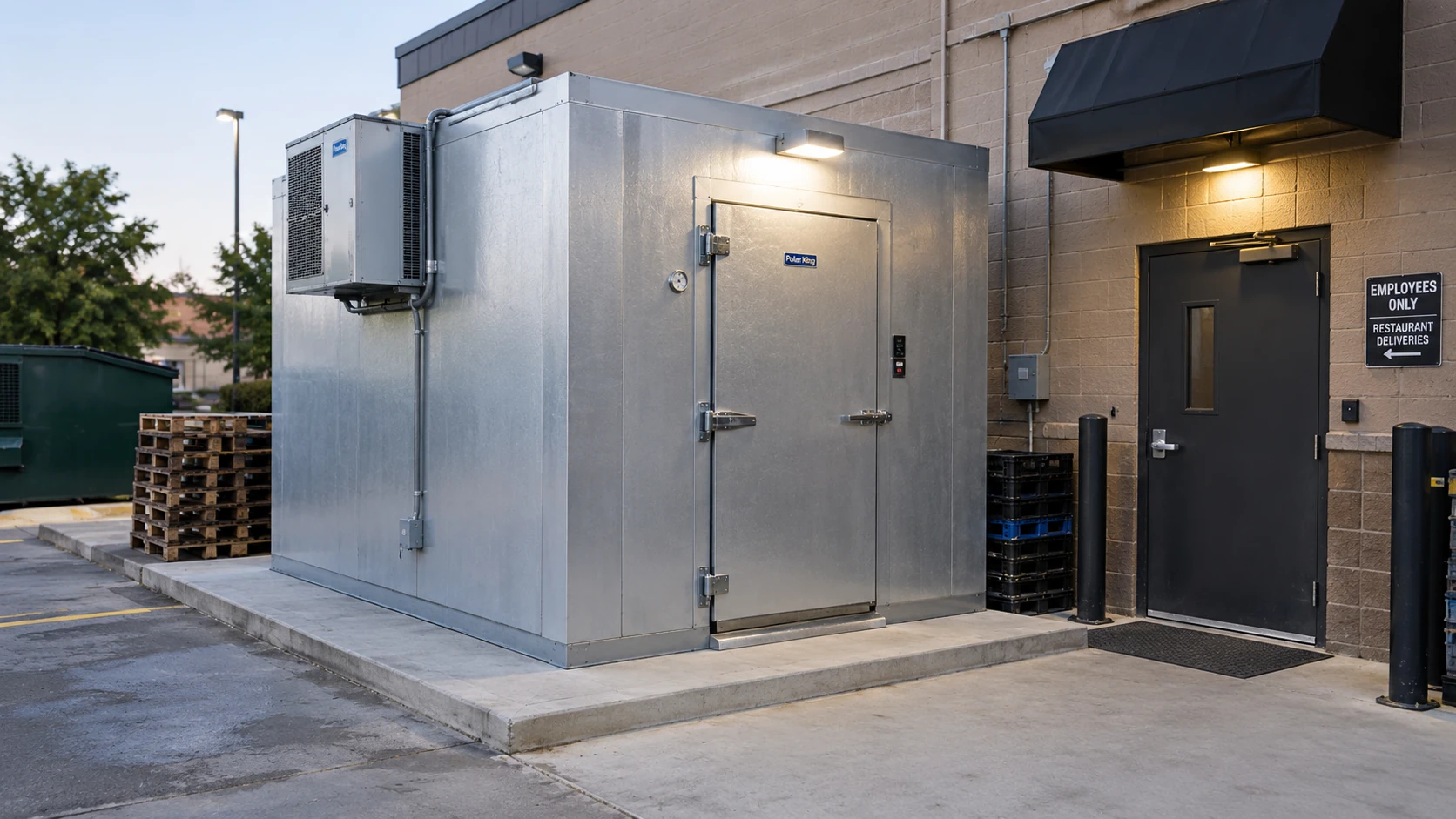
Outdoor walk-ins free up valuable floor space inside, which can be a game changer in a tight kitchen. The tradeoff is that an outdoor unit is not simply an indoor box left outside. It needs weather-resistant construction and components, and it generally needs a properly prepared level pad. Kentucky’s mix of humid summers, cold snaps, and storms makes that weather protection worth taking seriously. Staff also have to walk outside to reach it, which matters for workflow and winter conditions.
A quick way to think about it: if interior space is your biggest constraint and you have a suitable spot outside, outdoor deserves a look. If your kitchen has room and you want the fastest access for your crew, indoor usually fits better.
Floor or No Floor
Walk-ins can be ordered with an insulated floor or without one. A floorless unit sits directly on a level slab, which lets you roll carts and pallets in without a ramp. A unit with a built-in floor is insulated from below and is often the better choice when the surface underneath is not ideal or when the walk-in will sit on an upper level.
The important part is the surface you are building on. Panels and doors need a flat, level base to seal properly, and an uneven slab can lead to gaps, air leaks, and doors that never quite close right. Ask your installer to evaluate the floor before you commit to either option.
Refrigeration System Options
The walk-in box is only half of the equation. The refrigeration system that cools it is just as important.
Walk-in refrigeration systems are typically either self-contained with the compressor mounted on top of the unit, or remote, where the condensing unit sits somewhere else, such as on a roof, outside wall, or mechanical area. Each setup has different tradeoffs:
- Top-mounted systems are often simpler to install and a common choice for smaller indoor boxes, but they add heat and noise near the unit.
- Remote systems move the heat and sound away from the kitchen and can be a better fit for larger boxes or tight indoor spaces, though they require refrigerant lines and a place to put the condensing unit.
Whatever you choose, the system has to be matched to the box and its conditions. A refrigeration system sized for a cool, shaded spot will struggle in a hot mechanical room or on a sun-baked wall in August. Installers calculate this by looking at the box size, insulation, door traffic, product load, and ambient temperature, which is another reason to talk to someone who does this work every day rather than simply buying a box online.
Doors, Shelving, and the Details That Affect Daily Use
The small features are what your staff will notice every single day.
- Door type: Traffic doors are built for frequent in and out access. Display doors, with glass fronts, show product to customers or staff and are common in convenience stores, beverage shops, and florists.
- Strip curtains: Plastic strip doors help keep cold air in when the main door is propped open during deliveries and restocking, and they help keep pests out.
- Shelving: Good shelving keeps food organized and off the floor, which supports food safety and makes inventory faster. Match the shelf type to what you store.
- Lighting: Interior lighting should be bright, sealed, and rated for cold, damp conditions. Poor lighting leads to mistakes and wasted product.
- Door hardware and alarms: Inside release hardware and temperature alarms are worth asking about, especially if the walk-in is large or located in a back area.
Temperature and Food Safety
Your walk-in’s job is to keep food safe, so know the numbers. The FDA Food Code requires time and temperature controlled foods to be held at 41°F or below. Many operators set their walk-in cooler to run in the mid to upper 30s Fahrenheit, which gives a buffer so the box does not creep above the legal limit every time the door opens.
A few habits protect both your food and your equipment:
- Do not load hot food straight in. Large batches of hot product can overwhelm the system and raise the temperature of everything else inside. Health codes call for cooling cooked food from 135°F to 70°F within two hours, then to 41°F within another four hours, so use ice baths, shallow pans, or a blast chiller to bring food down first.
- Keep a thermometer inside and check it. Do not rely only on the digital readout on the outside. A separate thermometer and a written temperature log help you catch problems early and satisfy health inspectors.
- Keep the door closed. Propped doors and long loading sessions are among the most common causes of temperature swings.
Requirements can vary by jurisdiction, so check with your local health department about plan review and approvals before you finalize a layout, especially if you are opening a new restaurant or remodeling.
Energy Efficiency and Insulation
A walk-in cooler runs around the clock, so efficiency adds up quickly. Federal energy conservation standards apply to walk-in coolers and freezers sold in the United States, which means manufacturers have to meet certain minimum performance rules. Beyond those minimums, you can ask a few practical questions:
- What is the insulation R-value of the panels?
- What warranty comes with the panels and the refrigeration system?
- What kind of lighting and door gaskets are included?
- Are there features such as automatic door closers or anti-sweat controls that cut energy use?
Do not judge on purchase price alone. A cheaper unit with weaker insulation or a poorly matched system can cost more over its life in electricity and repairs than a better-specified one.
Planning the Installation
A walk-in installation touches several trades, and planning ahead saves headaches.
- Electrical: Walk-ins need dedicated electrical connections, and the requirements depend on the system. Have this reviewed early so you are not surprised by panel upgrades.
- Drainage and plumbing: The evaporator produces condensate that has to drain somewhere. Floor drains, sinks, or condensate pumps may be needed.
- Ventilation: Condensing units need airflow to reject heat. Cramped, hot spaces are a common cause of early failure.
- Access: Panels, equipment, and sometimes pallets have to physically reach the install location. Check hallways, doors, and delivery routes ahead of time.
- Permits and inspections: Your local building and health departments may require permits or reviews.
Rushing the planning stage is how a smooth project turns into a delayed one.
Why Service After the Sale Matters
The best walk-in cooler is one that keeps running. Every walk-in will eventually need maintenance, and the time to find out who services it is before you buy, not after the compressor quits. Ask any dealer these questions before you sign:
- Do you install and service the equipment you sell, or only sell it?
- What does your warranty cover, and for how long?
- Do you offer preventive maintenance programs?
- How quickly can a technician reach me if something fails?
Preventive maintenance is one of the cheapest forms of insurance in the food business. Cleaning coils, checking door seals, testing defrost cycles, and inspecting electrical connections catch small problems before they become expensive emergencies.
Questions to Ask Before You Buy
Before you commit to a walk-in cooler, walk through this short list:
- What exactly will I store, and how much of it at my busiest?
- Will the unit go indoors or outdoors, and is the site ready?
- Do I need a floor, or will it sit on a level slab?
- What refrigeration system matches my location and climate?
- What do the panels, doors, and shelving look like for my daily workflow?
- Who installs it, who services it, and how fast can they respond?
- What do I need to clear with my local health and building departments?
If you can answer these, you are ready for an accurate quote and a better outcome.
Talk to a Kentucky Team That Installs and Services Walk-In Coolers
If you are planning a walk-in cooler for a restaurant, grocery, bar, or other food business in Kentucky, Commercial Refrigeration of KY can help you work through the size, setup, and service questions before you buy. The team has served restaurants, grocers, florists, hotels, and other businesses since 1980, with locations in Campbellsville and Somerset, and handles the installation, maintenance, and repair of commercial refrigeration and kitchen equipment. Browse the equipment and brands we carry, then call or contact us to talk through your walk-in cooler project.
Add Comment