
The Catering Business Owner’s Guide to Buying Commercial Cooking Equipment
Starting a catering business in Kentucky means making a lot of decisions before you ever cook a single meal for a paying client. One of the biggest is figuring out which commercial cooking equipment to buy, how much to spend, and what actually matters versus what looks impressive in a showroom. Get it right and your kitchen runs efficiently from day one. Get it wrong and you are either replacing equipment within two years or hauling gear that is too heavy, too big, or completely wrong for the type of jobs you are booking.
This guide is written for catering business owners who want practical answers, not a sales pitch.
Why Catering Equipment Buying Decisions Are Different
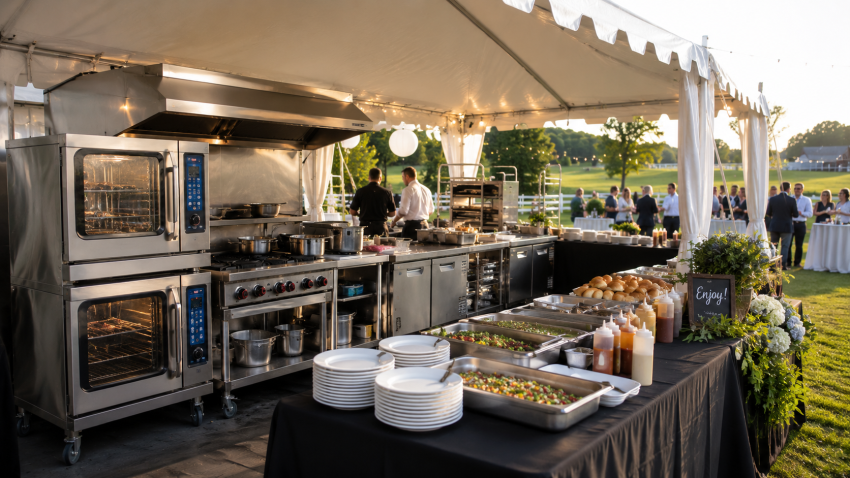
A restaurant operates out of a fixed location. The kitchen is built around the space, the menu, and the volume of covers the dining room can hold. Catering does not work that way. You are moving equipment, loading it into vehicles, setting it up at event venues, using it under varying conditions, and then breaking everything down and doing it again. That mobility requirement changes almost every equipment decision you will make.
A caterer also deals with inconsistent volume. Some weeks you are cooking for 30 guests at a private dinner, and two weeks later you are feeding 300 people at a corporate event. Your commercial cooking equipment needs to handle that range without being so oversized that it eats your budget when you are running smaller jobs.
The other thing that catches new catering operators off guard is the difference between commercial-grade equipment and the kind of heavy-duty residential gear that looks similar but is not built for professional use. Commercial cooking equipment is rated for continuous use, built to be serviced, and in many cases required by health departments and event venues as a condition of operating. Do not cut corners here.
Start With Your Menu, Not a Shopping List
The most common mistake catering business owners make when buying commercial cooking equipment is starting with equipment rather than food. Your menu should drive every purchase. A caterer who focuses on barbecue and smoked meats needs completely different equipment than someone doing plated fine dining or high-volume buffet service.
Before you spend a dollar, write out the five to ten dishes that will anchor your catering menu. Then work backwards and ask what equipment is required to produce each of those dishes at volume and at a mobile location. That process will surface your actual needs and eliminate a long list of equipment you thought you needed but do not.
From that exercise, most catering operations arrive at a core set of essential commercial kitchen equipment: a reliable commercial range or oven setup, holding equipment to keep food at safe serving temperatures, and prep equipment that can be transported and used on-site. Everything else is secondary until the business generates enough revenue to justify expanding.
The Core Equipment Every Catering Business Needs
Commercial Range and Oven
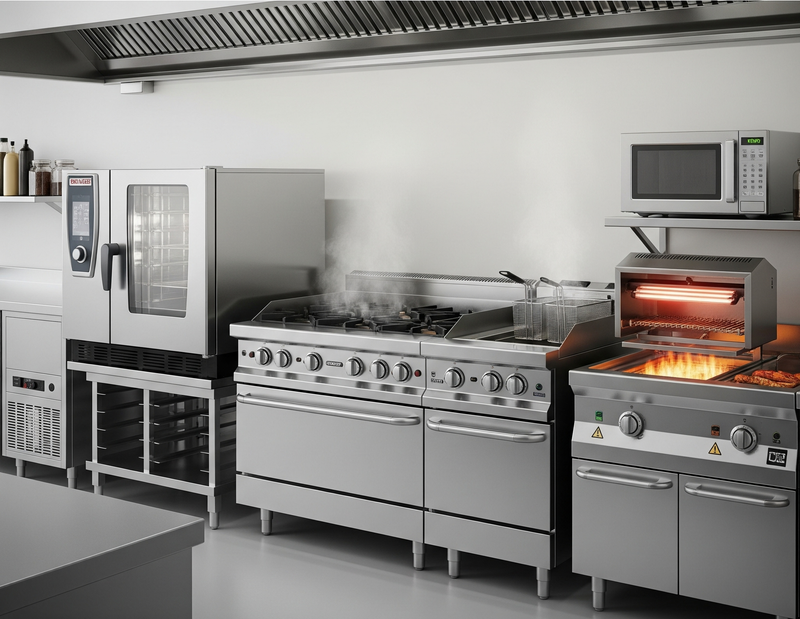
For most catering operations, the commercial range is the workhorse of the kitchen. A six-burner commercial range gives you the flexibility to run multiple dishes simultaneously without the limitations of residential equipment. When evaluating ranges, look at BTU output, grate quality, and how easy the unit is to clean after heavy use. These are the things that matter after six months of real catering jobs, not the specifications that look impressive on a spec sheet.
If your catering operation involves baking, roasting, or high-volume cooking that requires consistent oven heat, a commercial convection oven is worth serious consideration. Convection ovens cook faster and more evenly than conventional models, which matters when you are working against a tight event timeline and need to get 200 pieces of chicken to temperature at the same time.
Holding Equipment
This is where a lot of new catering operators underinvest and then regret it. Chafing dishes and hotel pans are a starting point, but commercial holding cabinets and hot boxes are what allow you to transport food safely, maintain correct holding temperatures, and serve consistently across a long event window. If food is sitting at the wrong temperature because you did not invest in proper holding equipment, you have a food safety problem, not just a quality problem.
Look at both electric holding cabinets for venue use and insulated transport carriers for mobile operations. Both serve different purposes and most growing catering businesses end up needing each.
Commercial Fryer
If fried food appears anywhere on your catering menu, a commercial fryer is not optional. A residential deep fryer cannot keep up with catering volume and is not compliant for commercial food service. A quality commercial fryer with the right oil capacity for your typical order size will pay for itself quickly if you are running consistent events.
Commercial Prep Equipment
A commercial food processor, a quality stand mixer if you do any baking, and a full set of stainless steel prep tables will cover most of your prep needs. Stainless work surfaces are durable, sanitary, and easy to clean, which matters when you are prepping in multiple locations over the course of a week.
New vs. Used Commercial Cooking Equipment
This is one of the most debated topics among catering operators just getting started, and the honest answer is that both options can work depending on what you are buying and where you are buying it from.
New commercial cooking equipment comes with manufacturer warranties, current energy efficiency standards, and the assurance that nothing has been abused by a previous owner. For high-use items like your primary range and oven, buying new is often the smarter long-term decision even if the upfront cost is higher.
Used equipment can be a legitimate way to stretch your startup budget, particularly for items like prep tables, shelving, holding cabinets, and transport equipment that take less of a beating than cooking equipment. The risk with used commercial kitchen equipment is that you often have no history on how it was maintained, whether it has been repaired multiple times, or whether parts are still available for it. If you buy used, buy from a reputable dealer who can provide service records, and have a technician inspect anything with a burner, motor, or compressor before you commit.
In Kentucky, working with a local commercial kitchen equipment dealer rather than an online marketplace gives you the ability to see equipment in person, ask questions, and build a relationship with someone who can service what they sell. That service relationship matters more than most first-time buyers realize.
Sizing Equipment for Catering Volume
One of the practical challenges of buying commercial cooking equipment for a catering business is that your volume is not fixed. Buying equipment sized only for your current bookings means you will outgrow it quickly if the business grows. Buying equipment sized for your maximum theoretical capacity means you are paying for capacity you do not use most of the time.
A reasonable approach is to size your core equipment for the upper end of your typical booking range rather than your maximum possible event. If most of your events run between 50 and 150 guests, buy equipment that handles 150 guests comfortably. You can rent supplemental equipment for the occasional 300-person event without the ongoing cost of equipment sized for that volume.
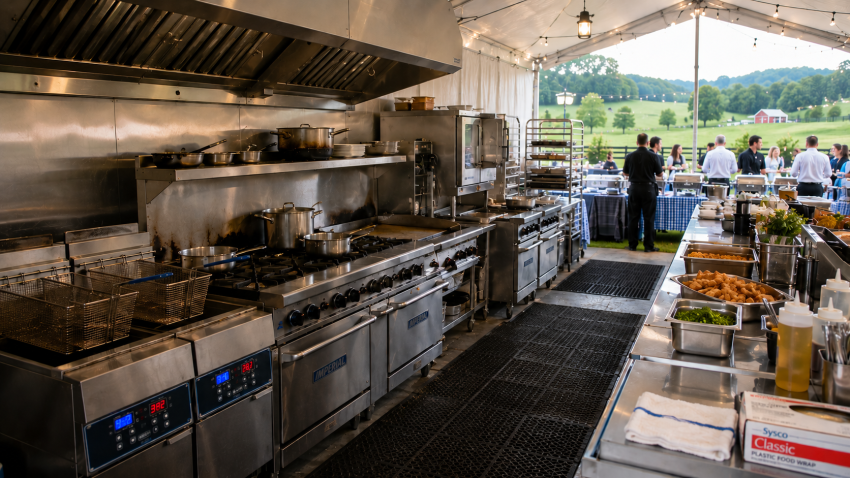
Also consider whether the equipment you are buying can actually fit in your vehicle, your prep kitchen, and the venues you commonly work. A caterer in central Kentucky working in barns, event halls, and private properties needs equipment that is manageable to move, set up, and break down. A massive commercial range that requires two people and a hand truck to move is a liability if most of your events involve tight setups.
Budget Realities for Commercial Cooking Equipment
There is no way to accurately quote what your equipment package will cost without knowing your menu, your volume, and your specific situation. What is realistic is to understand the categories of cost and plan accordingly.
Entry-level commercial cooking equipment packages for a startup catering business can run anywhere from $15,000 to $40,000 depending on whether you are buying new or used and how comprehensive the package is. That range covers a commercial range, a convection oven, a fryer, holding equipment, and basic prep gear.
Do not underestimate the cost of ancillary items that do not show up on the first shopping list: sheet pans, hotel pans, transport racks, smallwares, and the ongoing cost of maintenance. Commercial cooking equipment requires regular service to stay in safe operating condition, and that cost should be in your budget from the start.
If upfront cash is a constraint, look at financing options. Many commercial equipment dealers in Kentucky offer financing programs through partners like Marlin Finance and Navitas, which allow you to spread the cost of a full equipment package over time while still starting with commercial-grade gear rather than residential substitutes.
The Maintenance Question Most Buyers Ignore
Buying commercial cooking equipment is the first decision. Keeping it running is the ongoing one, and it is one most first-time catering operators do not think about until something breaks in the middle of a busy booking period.
Commercial ovens, fryers, and ranges need regular cleaning, calibration, and inspection to stay in compliance and to last their full service life. Burners clog, thermostats drift, fryer elements fail, and door seals wear out. None of these are emergencies if you catch them through routine maintenance, but all of them become expensive emergencies if you do not.
The practical advice here is to find a commercial kitchen equipment service provider in your area before you need one, not during a crisis. In Kentucky, that means having a local technician you can call who knows your equipment, can get parts quickly, and understands the demands of food service operations. A catering business running events every weekend cannot afford to wait a week for a service call.
Building a preventive maintenance schedule for your commercial cooking equipment is one of the most straightforward ways to protect your investment and keep your operation running without surprises.
What to Ask Before You Buy
Before committing to any piece of commercial cooking equipment, work through these questions:
Does this equipment fit the specific cooking methods my menu requires? Can it be transported and set up efficiently at the types of venues I work? Is the manufacturer still active and are parts available? Who services this brand in Kentucky if something goes wrong? Does it meet the health code and compliance requirements in my county? Can I get it financed if I need to spread the cost?
If you can answer all of those clearly, you are making a purchase decision rather than a hope-based one.
Getting the Right Advice Before You Spend
Talking to a commercial kitchen equipment dealer who services what they sell is worth more than hours of online research. A dealer who handles installation, maintenance, and repair has direct experience with what holds up in real-world food service use and what does not. They can also flag equipment that looks good in a catalog but has a reputation for reliability problems or limited parts availability.
In Kentucky, Commercial Refrigeration of KY has been selling and servicing commercial cooking equipment for catering businesses, restaurants, grocers, and food service operators since 1980. If you are building out your first catering kitchen or replacing equipment that has reached the end of its service life, getting a conversation started before you buy is the kind of step that saves money and frustration down the road.
Explore our commercial cooking equipment showroom to see what we have in store and how we support catering and food service businesses across Kentucky, or call us at (270) 465-2910 to talk through what your catering operation actually needs before you spend a dollar.
Add Comment